Bottom Line Up Front
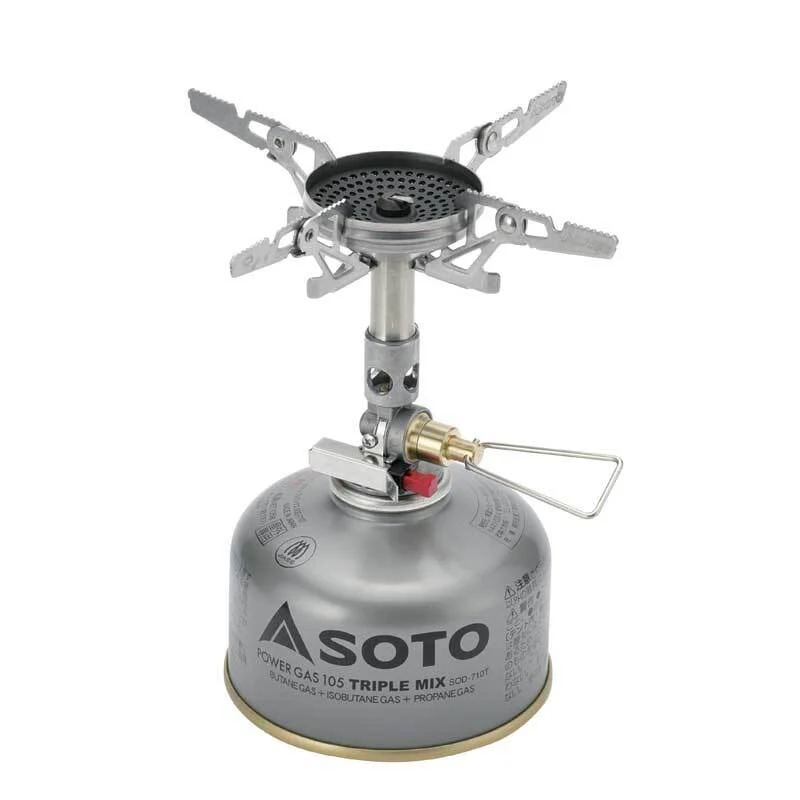
The Soto Windmaster is an excellent ultralight canister stove — but it is frequently misunderstood and occasionally mis-bought. At 67g it looks dramatically lighter than an integrated system like the Jetboil Flash at 371g. The reality is more nuanced: the Windmaster requires a separate pot, which adds weight, cost, and bulk back into the equation. Factor in a quality titanium pot at 80–100g and your total system weight is around 150–170g — still lighter than the Jetboil Flash, but the gap is far smaller than the headline stove weight suggests.
Buy the Windmaster if you want a flexible, lightweight cooking system and are comfortable managing separate components. Buy an integrated system if you want simplicity, convenience, and everything in one compact unit.
Key Specifications
| Feature | Value |
|---|---|
| Stove weight | 67g |
| Pot support | 4-flex foldable |
| Ignition | Micro igniter |
| Boil time (500ml, calm) | ~2.5 mins |
| Wind resistance | High |
| Fuel type | Isobutane/propane canister |
| Compatible pots | Most canister stoves pots |
| Price (AUD) | $90–$130 |
| Pot included | No — separate purchase |
| Total system weight (with Ti pot) | ~150–170g |
The Weight Comparison — What the Numbers Actually Mean
This is the most important thing to understand before buying the Windmaster and most reviews gloss over it.
The Windmaster weighs 67g. The Jetboil Flash weighs 371g. That looks like a 304g saving. It is not.
The Windmaster is a stove only. It has no pot, no cooking vessel, no lid. To cook anything you need to add a pot, which for a quality ultralight titanium option adds another 80–100g to the system. A Toaks 550ml titanium pot with lid weighs around 93g — widely available in Australia and one of the most popular pairings with the Windmaster.
Real system weight comparison:
| System | Stove | Pot | Total |
|---|---|---|---|
| Soto Windmaster + Toaks Ti pot | 67g | 93g | ~160g |
| Jetboil Flash | 371g | Included | 371g |
| MSR WindBurner | 453g | Included | 453g |
The Windmaster system is genuinely lighter — about 210g lighter than the Jetboil Flash. That is meaningful for weight-conscious hikers. But it is not the 300g saving the headline stove weight implies, and it comes with trade-offs in convenience and packability that are worth understanding before you commit.
The Packability Reality
The Jetboil Flash and MSR WindBurner are cleverly engineered all-in-one systems — the burner, canister stand, and a 100g gas canister all nest inside the cooking pot, creating one compact cylindrical unit. Everything you need in one organised package that takes up a defined, predictable amount of space in your pack.
The Windmaster with a separate titanium pot is not that. You have a stove that folds flat, a pot that may or may not nest with your other gear, a canister that lives somewhere, a lid that needs to go somewhere else. If you choose the right pot it can pack efficiently — many titanium pots are sized to fit a 100g canister inside them, which helps. But if you make the wrong choice on pot size or shape you can end up with a cooking system that takes up more space than an integrated solution, despite the Windmaster being marketed as the compact option.
The lesson: if you buy a Windmaster, research your pot choice carefully. The Toaks 550ml or similar titanium pots that nest with a 100g canister are the right pairing. A random pot from a camping store may not be.
What the Windmaster Does Well
Wind resistance is genuinely impressive for a non-integrated stove. The micro-regulator technology maintains consistent gas pressure and the burner design provides strong wind resistance — significantly better than a standard canister stove like the MSR PocketRocket. For exposed Australian conditions — alpine NSW, Tasmanian ridges, coastal trails with sea winds — this is a real advantage.
Fuel efficiency is excellent. The Windmaster uses gas conservatively, meaning a 100g canister stretches further than with many competing stoves. For multi-day trips where you are carrying your fuel for the whole trip, this matters.
Versatility is the genuine differentiator over integrated systems. Because the Windmaster accepts different pot sizes via its four-flex pot support, you can choose your cooking vessel based on your actual needs — a small 400ml mug for solo boiling, a 900ml pot for cooking meals for two, or anything in between. If you like cooking real meals on trail rather than just rehydrating bags, this flexibility is genuinely valuable. Integrated systems lock you into their specific vessel.
Price is a significant advantage. At $90–$130 AUD for the stove, plus $40–$80 for a quality titanium pot, your total outlay is $130–$210 AUD — meaningfully cheaper than a Jetboil Flash at $180–$220 or an MSR WindBurner at $280–$320.
Who Should Buy the Windmaster
Buy the Windmaster if:
- You are starting out and want to test multi-day hiking without spending $200+ on an integrated system
- You like cooking real meals on trail and want pot flexibility
- You are already experienced and want maximum weight savings and are comfortable managing separate components
- You hike in groups and want to share a pot between multiple people
- Budget is a priority and you are willing to do the research on pot pairing
Buy an integrated system (Jetboil Flash or MSR WindBurner) instead if:
- You primarily rehydrate freeze-dried meals or boil water — you do not need pot flexibility
- You value having one compact, organised cooking unit
- You prefer not to think about component compatibility
- You are an experienced hiker who has decided convenience is worth the weight premium
The Honest Caveat for New Hikers
If you are buying your first dedicated hiking stove, the Windmaster requires more research and decision-making than an integrated system. You need to choose a compatible pot, understand how to pack both components efficiently, and accept that your cooking system will be slightly less organised than a Jetboil.
None of this is difficult — but it is worth knowing upfront. The Windmaster is marketed at its stove weight of 67g which can make integrated systems look unnecessarily heavy by comparison. When you add a pot the comparison is much closer, and the integrated systems’ convenience advantage becomes more relevant.
Do not buy the Windmaster assuming it is a complete solution for $90. Budget for a quality pot alongside it.
Australian Availability
The Soto Windmaster is available at Paddy Pallin, Wild Earth, and Backpacking Light Australia, as well as on Amazon AU and eBay AU. It retails at $90–$130 AUD. Compatible titanium pots are available at the same retailers — budget $40–$80 for a quality option.
Check price on Amazon
Check price on eBay
Verdict
The Soto Windmaster is a genuinely excellent ultralight stove that delivers strong wind resistance, good fuel efficiency, and real cooking versatility at a competitive price. For weight-conscious hikers who want flexibility in their cooking setup, it is one of the best options available.
Just go in with clear eyes on the total system — stove plus pot — and make sure you choose the right pot pairing before you leave for the trail.
Best for: Weight-conscious hikers, budget buyers, group hikers, trail cooks who want pot flexibility, experienced ultralight hikers
Not for: Hikers who want a complete all-in-one system, beginners who want simplicity, those who primarily rehydrate dehydrated meals
The Soto Windmaster is a high-performance ultralight stove designed to provide strong performance in windy conditions. It is known for its efficiency and reliability.
TrailKitLab — written by hikers, for hikers
1 thought on “Soto Windmaster Review — The Best Ultralight Stove for Hikers Who Know What They’re Doing”