Bottom Line Up Front
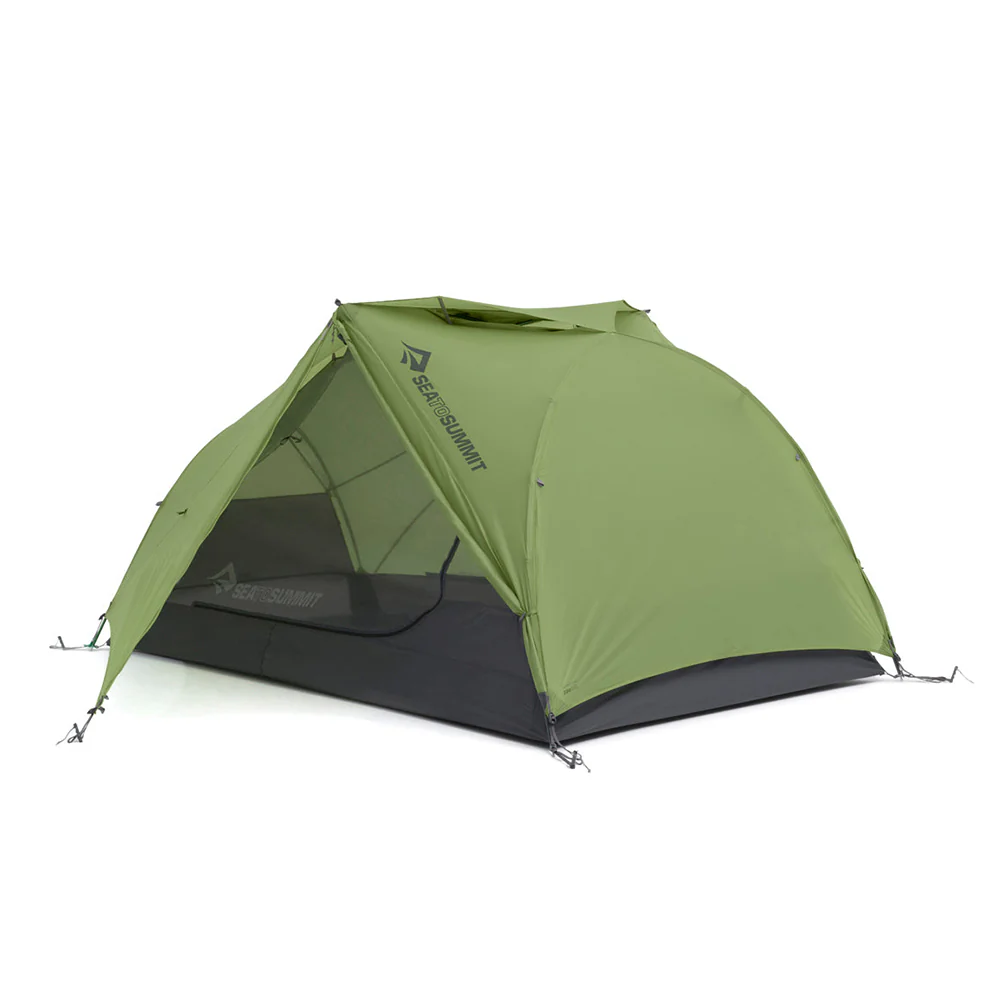
The Sea to Summit Telos TR2 is the most spacious and feature-rich ultralight two-person tent available to Australian hikers. Its Tension Ridge architecture delivers genuinely exceptional headroom, the fully freestanding design makes campsite selection on rocky Australian terrain significantly easier, and the FairShare three-bag storage system is a genuinely useful feature for hiking pairs.
The honest caveat: at $849 AUD and 1.48kg it is the most expensive and heaviest tent in this comparison category. You are paying a significant premium for features that experienced ultralight hikers may not value — particularly Hangout Mode, which requires trekking poles most hikers don’t carry and creates a shelter so small you’d be better off sitting on a nearby log.
If you are doing multi-day hikes in Australian conditions where campsite selection is unpredictable, you regularly share a tent with a partner, and you value maximum interior space and ventilation — the Telos TR2 earns its price. If you are weight-conscious and want a simpler setup, the Tiger Wall UL2 or Nemo Hornet 2P deliver most of the experience at a lower weight and price.
Key Specifications
| Feature | Value |
|---|---|
| Weight | ~1.48kg |
| Capacity | 2 person |
| Architecture | Fully freestanding |
| Peak height | 110cm |
| Floor area | 2.6 sqm |
| Vestibules | 2 large |
| Setup modes | 6 configurations |
| Ventilation | Apex vent + baseline vents |
| Storage system | FairShare — 3 separate bags |
| Price (AUD) | ~$849 |
| Brand origin | Australian — Sea to Summit |
| Best use | Multi-day backpacking, 3-season |
The Fully Freestanding Advantage — Why It Matters in Australia
This is the Telos TR2’s most practical differentiator over the Tiger Wall UL2 and Nemo Hornet 2P, both of which are semi-freestanding and require stakes to pitch properly.
A fully freestanding tent stands on its own without any pegging. You pitch it, pick it up, move it, reposition it, and only stake it out once you are happy with the spot. On well-maintained trails with designated tent platforms this distinction barely matters. On more technical Australian terrain — rocky sections of the Blue Mountains, granite slabs in alpine NSW, informal bush camping spots where finding four good stake points requires patience and creativity — the ability to pitch anywhere and adjust freely is a genuine advantage.
If you have ever spent twenty minutes on a rocky campsite trying to find workable ground for a semi-freestanding tent, you understand the value. The Telos removes that problem entirely. For Australian hikers who regularly camp off-track or in environments where the ground is uncooperative, this alone can justify choosing the Telos over lighter alternatives.
Tension Ridge Headroom — The Real Differentiator
The Telos TR2’s signature design feature is the Tension Ridge — a crossbar pole that angles upward rather than downward, pushing the ceiling away from occupants rather than toward them. The result is 110cm of peak height with near-vertical side walls that create genuinely usable interior space from floor to ceiling.
In practice this means two adults can sit upright side by side without touching the tent walls — something that is simply not possible in the Tiger Wall UL2 at 107cm or the Nemo Hornet at 97cm. The difference sounds modest in numbers but is immediately obvious in use. On a multi-day trip where you spend genuine time inside the tent — waiting out an afternoon storm on the Overland Track, having a rest day in Fiordland, getting changed on a cold morning — the Telos interior feels like a different category of tent to its competitors.
The large, high doors are a secondary benefit of this architecture — getting in and out of the Telos is significantly easier than most ultralight tents, which require contorting through a low opening.
Ventilation — A Genuinely Useful Feature
The Telos has an apex vent positioned at the highest point of the tent that allows warm, moist air to escape efficiently, plus adjustable baseline vents near the floor. This dual-vent system is specifically designed to reduce condensation — the build-up of moisture inside the tent from breath and body heat that is an unavoidable reality on multi-day trips, especially for two people sharing.
Condensation matters more than most hikers realise until they experience a prolonged wet trip. Over multiple days, moisture builds inside any tent regardless of brand. A good ventilation system reduces this meaningfully — keeping the interior drier, your sleeping bag drier, and your overall comfort level higher.
For Australian conditions this is a relevant feature. The Overland Track in autumn, the Grampians in winter, New Zealand — any trip where you are inside the tent for extended periods in cool, moist conditions will benefit from the Telos ventilation design. It is not a gimmick.
Hangout Mode — Honest Assessment
Hangout Mode converts the Telos rainfly into a semi-open communal shelter using a pair of trekking poles or a separately sold pole set. The fly rolls up and is supported at each end to create a covered outdoor space.
The honest verdict: it is a gimmick for most hikers.
To use Hangout Mode you need trekking poles, which not every hiker carries. The covered area it creates is small — enough for two people to crouch under, not a comfortable communal space. On a hot sunny day on the Larapinta you would be far more comfortable finding shade under a rock overhang or tree. On a rainy afternoon on the Overland Track you would simply get inside the tent. The scenarios where Hangout Mode is both available and preferable to the obvious alternatives are narrow.
It is a creative engineering feature and worth knowing about. But if Hangout Mode is the primary reason you are considering the Telos over the Tiger Wall, reconsider.
FairShare Storage System — Genuinely Useful
This is one of the Telos’s more practical innovations. The tent packs into three separate stuff sacks — one for the inner body, one for the rainfly, one for the poles. Two hiking partners can split the tent between their packs, distributing the 1.48kg load rather than one person carrying it all.
Other tents can technically be split between hikers too, but the separate bags make it natural and organised. For hiking pairs doing multi-day routes where pack weight is shared deliberately — the Overland Track, Larapinta, New Zealand — the FairShare system makes the Telos’s higher weight less of a real-world concern. Effectively each hiker carries 740g of tent rather than one carrying 1.48kg. At that per-person weight it is suddenly competitive with lighter alternatives.
The Weight Question — In Context
At 1.48kg the Telos is 350g heavier than the Tiger Wall UL2 and 400g heavier than the Nemo Hornet 2P. For a solo carrier that is a meaningful difference. For a pair using the FairShare system it is 740g each — barely different from carrying a Tiger Wall solo.
This reframes the decision significantly. If you are hiking with a regular partner and will always split the tent, the Telos’s weight penalty largely disappears. If you regularly carry the tent solo or hike with different partners, the 350–400g premium is real and worth considering against what you gain.
Who Should Buy the Telos TR2
Buy the Telos TR2 if:
- You regularly hike in rocky or unpredictable terrain where fully freestanding pitch is a genuine advantage
- You have a regular hiking partner and will always use the FairShare system — the per-person weight is competitive
- You prioritise maximum interior space and ventilation above all else
- You are doing routes where condensation management matters — Overland Track, Tasmanian alpine, New Zealand multi-day
- You value the Sea to Summit Australian brand and direct local support
Do not buy this tent if:
- Weight is your primary concern and you hike solo or carry the full tent
- You want a simple, lighter setup — the Tiger Wall UL2 or Nemo Hornet deliver 90% of the experience at lower weight and cost
- You are drawn to Hangout Mode as a feature — it requires trekking poles and the use cases are narrow
- Budget is a significant factor — at $849 AUD it is $200 more than the Tiger Wall and $300 more than the Hornet
Who should not buy any ultralight tent:
- Day hikers and casual campers — these tents are overkill and undersized for non-hiking use
- Car campers — a $200 dome tent is more practical and comfortable for this use case
Sea to Summit Telos TR2 vs Tiger Wall UL2 vs Nemo Hornet 2P
| Feature | Telos TR2 | Tiger Wall UL2 | Nemo Hornet 2P |
|---|---|---|---|
| Weight | 1.48kg | 1.13kg | 1.08kg |
| Architecture | Fully freestanding | Semi-freestanding | Semi-freestanding |
| Peak height | 110cm | 107cm | 97cm |
| Rocky terrain | ✅ Best | Manageable | Manageable |
| Interior space | ✅ Best | Good | Cosy |
| Ventilation | ✅ Best | Good | Good |
| Split carry | ✅ FairShare | Manual | Manual |
| Price AUD | $849 | $580–$650 | $480–$580 |
| Australian brand | ✅ Yes | No | No |
| Best for | Pairs, rocky terrain, comfort | 2-person multi-day | Solo, ultralight |
Australian Availability
The Telos TR2 is available at Paddy Pallin, Snowys, Wild Earth, and direct from seatosummit.com.au. It is also available on Amazon AU and eBay AU. Listed as the Sea to Summit Telos Plus on Amazon AU — select TR2 from the size options. At $849 AUD it is at the premium end of the ultralight tent category — Paddy Pallin and Snowys occasionally stock it on sale, worth checking before buying at full price.
Verdict
The Sea to Summit Telos TR2 is an exceptional tent that delivers best-in-class headroom, the only fully freestanding design in this category, and a genuinely useful split-carry system for hiking pairs. It is the right choice for Australian hikers who camp in unpredictable terrain, value interior space and ventilation, and have a regular hiking partner to share the load.
The price and weight premium are real. For hikers who want a simpler, lighter setup the Tiger Wall UL2 is a stronger recommendation at $200 less. But for the specific buyer the Telos is designed for, it is worth every dollar.
Best for: Hiking pairs, rocky terrain, Overland Track, Tasmanian alpine routes, New Zealand multi-day, hikers who prioritise interior space and condensation management
Not for: Solo hikers carrying full tent weight, weight-minimisers, budget-conscious buyers, Hangout Mode enthusiasts without trekking poles
Check Price on Amazon
Check Price on eBay
TrailKitLab — written by hikers, for hikers
1 thought on “Sea to Summit Telos TR2 Review – The Most Liveable Ultralight Tent for Australian Hikers?”